1
Subtract coordinates
Find the signed horizontal, vertical, and—when needed—depth changes between the endpoints.
Δx = x₂ − x₁, Δy = y₂ − y₁, Δz = z₂ − z₁Find the exact and decimal distance between two points in a 2D coordinate plane or 3D space, with every formula step shown.
Enter Cartesian coordinates. Negative values and decimals are supported.
The Euclidean distance formula is the Pythagorean theorem applied to coordinates. The horizontal and vertical changes form the legs of a right triangle, while the line joining the points is its hypotenuse.
Find the signed horizontal, vertical, and—when needed—depth changes between the endpoints.
Δx = x₂ − x₁, Δy = y₂ − y₁, Δz = z₂ − z₁Square each coordinate difference so every contribution is nonnegative, then add them.
d² = Δx² + Δy² (+ Δz²)The positive square root of the squared distance is the straight-line distance.
d = √d²Find the distance between (−2, −3) and (−4, 4). Keeping the subtraction order consistent gives Δx = −2 and Δy = 7. Squaring removes the signs.
The exact answer is √53 units and the decimal approximation is 7.28 units. Reversing the two points changes the signs of both coordinate differences, but their squares—and therefore the distance—remain the same.
Label the first point (x₁, y₁) and the second (x₂, y₂). The subscripts identify matching coordinates; they are not exponents. Substitute each ordered pair without mixing x- and y-values.
When one endpoint is (0, 0), the formula simplifies to √(x² + y²). This is also the magnitude of the position vector from the origin to the point.
An exact radical such as √53 preserves the full mathematical value. A decimal such as 7.28 is rounded for measurement or comparison. This tool shows both when integer coordinates permit it.
Add the squared z-coordinate difference for 3D space. The result is the straight-line length between two positions in a Cartesian x-y-z system.
A midpoint is a coordinate, while distance is a nonnegative length. Averaging coordinates does not measure how far apart the points are.
Put negative coordinates in parentheses before subtracting, then square the complete difference.
Use x₂ − x₁ and y₂ − y₁ together. Do not reverse just one coordinate difference.
Keep the exact square root through the intermediate steps and round only the final decimal result.
Measure line segments, triangle sides, diagonals, radii, and distances from the origin.
Check object proximity, collision ranges, camera movement, and 2D or 3D vector lengths.
Measure displacement between positions represented in Cartesian coordinate systems.
Euclidean distance can compare numeric observations in clustering and nearest-neighbor methods after appropriate scaling.
For points (x₁, y₁) and (x₂, y₂), the 2D distance formula is d = √((x₂ − x₁)² + (y₂ − y₁)²). It measures straight-line Euclidean distance on a coordinate plane.
Subtract corresponding coordinates, square each difference, add the squares, and take the square root. This calculator performs those steps and displays both an exact radical and decimal approximation when possible.
The horizontal and vertical coordinate changes form perpendicular legs of a right triangle. The segment joining the points is the hypotenuse, so its length follows a² + b² = c².
No. Reversing the points changes the sign of every coordinate difference, but squaring removes those signs. Keep the subtraction order consistent within a calculation to avoid mistakes.
Substitute negative coordinates with parentheses, then subtract carefully. A negative difference is valid because its square is positive. For example, (−6)² equals 36, not −36.
For (x₁, y₁, z₁) and (x₂, y₂, z₂), use d = √((x₂ − x₁)² + (y₂ − y₁)² + (z₂ − z₁)²). It extends the same Pythagorean idea into three dimensions.
Use the origin as the first point. In 2D, the distance from (0, 0) to (x, y) is √(x² + y²). In 3D, add z² inside the square root.
Euclidean distance is the ordinary straight-line distance between points. The coordinate distance formula calculates this metric in 2D, 3D, or higher-dimensional Cartesian spaces.
The distance formula returns one nonnegative length. The midpoint formula averages corresponding coordinates and returns the point halfway between the endpoints.
Yes. The distance is zero only when every corresponding coordinate is equal, meaning both entries describe the same point.
The answer uses the same unit represented by the coordinate axes. If the coordinates are measured in meters, the distance is in meters; if no measurement unit is specified, report the answer in coordinate units.
No. It calculates straight-line Cartesian distance. Latitude and longitude require a spherical or ellipsoidal Earth formula, while driving distance requires a road-routing service.
Useful tools selected for this workflow
Calculate the missing side of a right triangle using the Pythagorean theorem (a² + b² = c²). Free online calculator with step-by-step solutions.
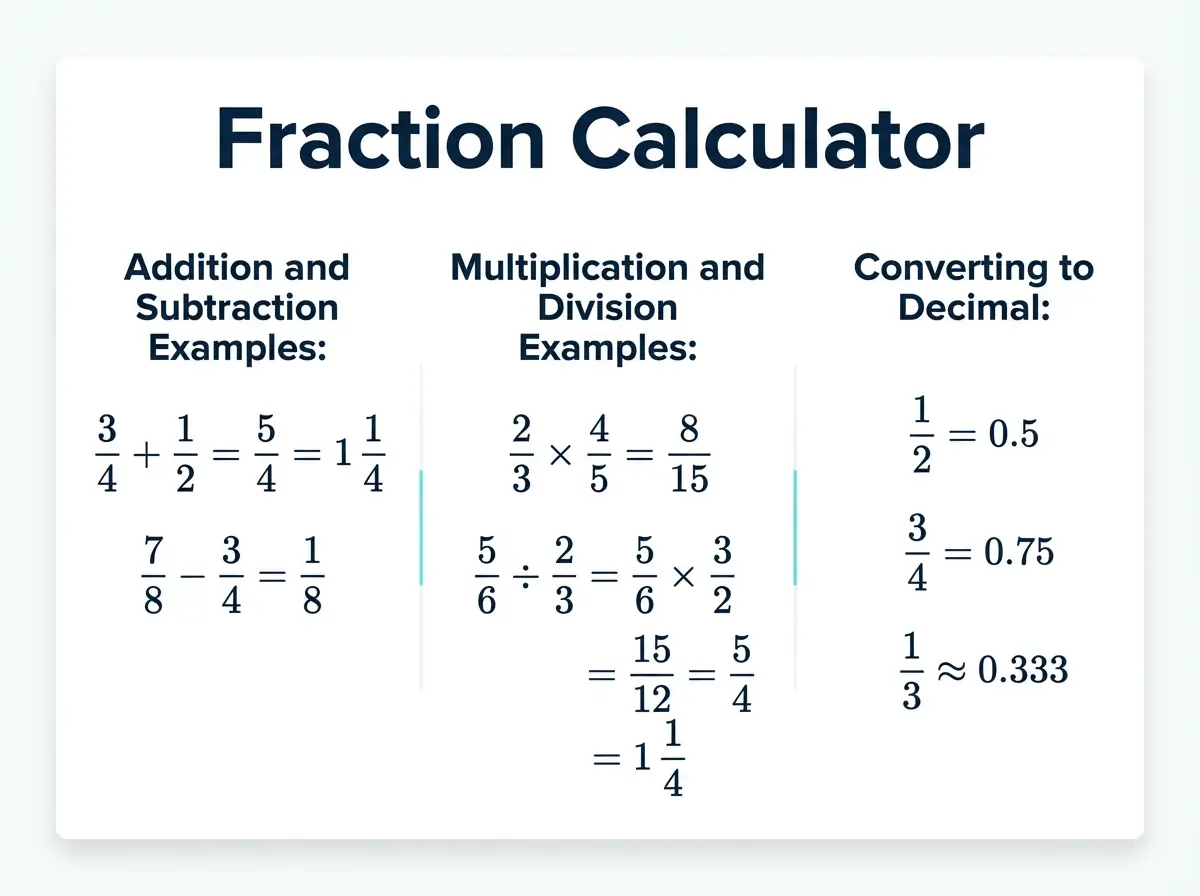
Add, subtract, multiply, and divide fractions. Simplify fractions, convert decimals, and work with mixed numbers easily.
Calculate the average, sum, count, median, mode, range, minimum, maximum, and weighted average for a list of numbers.
Find the least common multiple of two or more integers with exact BigInt results, GCF, prime factorization, formulas, and calculation steps.
Solve A:B = C:D, find missing ratio values, simplify equivalent ratios, scale proportions, calculate percentages, and view ratio diagrams.

Evaluate mathematical expressions with this free online tool. Perfect for solving complex equations, calculating values, and more.