📐 Pythagorean Theorem Calculator
Calculate the missing side of a right triangle using a² + b² = c²
Enter Values
Results
Enter two values to calculate
Understanding the Pythagorean Theorem
The Pythagorean Theorem is one of the most fundamental principles in Euclidean geometry. It describes the relationship between the three sides of a right triangle, where the square of the hypotenuse (the side opposite the right angle) equals the sum of the squares of the other two sides.
This theorem is named after the ancient Greek mathematician Pythagoras of Samos (c. 570–495 BC), though evidence suggests the relationship was known to Babylonian and Indian mathematicians centuries earlier. The theorem has been proven in hundreds of different ways, making it one of the most proven theorems in mathematics.
📜 History and Famous Proofs
The Pythagorean theorem has a rich history spanning thousands of years and multiple civilizations:
- Babylonians (1800 BC): Clay tablets show knowledge of Pythagorean triples
- India (800-400 BC): Baudhayana Sulba Sutra contains the theorem
- China (1000 BC): Known as the Gougu theorem
- Greece (500 BC): Pythagoras provided the first known proof
- Euclid's Proof: Using similar triangles (Elements, Book I)
- Garfield's Proof: By U.S. President James Garfield (1876)
- Einstein's Proof: Using similar triangles at age 12
- Over 400 proofs documented in "The Pythagorean Proposition"
The theorem's elegance lies in its simplicity and the countless ways it can be proven—from geometric rearrangements to algebraic manipulations, making it a cornerstone of mathematical education worldwide.
🌍 Real-World Applications
The Pythagorean theorem is not just a mathematical curiosity—it has countless practical applications in everyday life and professional fields:
Ensuring walls are perpendicular, calculating roof pitches, and laying foundations using the 3-4-5 rule.
Calculating shortest distances between two points, essential for GPS systems and aviation.
TV and monitor sizes are measured diagonally—the hypotenuse of the screen rectangle.
Calculating distances between objects, collision detection, and 3D rendering.
Measuring field distances, analyzing player movements, and optimizing strategies.
Calculating distances to stars and planets using triangulation methods.
📊 Related Formulas for Right Triangles
| Property | Formula | Description |
|---|---|---|
| Area | A = (a × b) / 2 | Half the product of the two legs |
| Perimeter | P = a + b + c | Sum of all three sides |
| Altitude to Hypotenuse | h = (a × b) / c | Height from right angle to hypotenuse |
| Inradius | r = (a + b - c) / 2 | Radius of inscribed circle |
| Circumradius | R = c / 2 | Radius of circumscribed circle |
| Median to Hypotenuse | m = c / 2 | Line from right angle to midpoint of c |
Common Pythagorean Triples
A Pythagorean triple consists of three positive integers a, b, and c that satisfy the equation a² + b² = c². These special number sets form the sides of right triangles with whole number measurements.
| a | b | c (hypotenuse) | a² + b² | c² |
|---|---|---|---|---|
| 3 | 4 | 5 | 25 | 25 |
| 5 | 12 | 13 | 169 | 169 |
| 8 | 15 | 17 | 289 | 289 |
| 7 | 24 | 25 | 625 | 625 |
| 20 | 21 | 29 | 841 | 841 |
📐 Special Right Triangles
Side ratios: 1 : 1 : √2
If legs = a, then hypotenuse = a√2
Side ratios: 1 : √3 : 2
Short leg : Long leg : Hypotenuse
Right-Triangle Formulas, Triples, and Limits
The Pythagorean theorem states that in a right triangle, the square of the length of the hypotenuse (c) equals the sum of the squares of the other two sides (a and b). Mathematically: a² + b² = c². This fundamental relationship only applies to triangles with a 90-degree angle.
No, the Pythagorean theorem only works for right triangles (triangles with one 90° angle). For other triangles, you need to use the Law of Cosines: c² = a² + b² - 2ab·cos(C), which is a generalization of the Pythagorean theorem.
A Pythagorean triple is a set of three positive integers (a, b, c) that satisfy the equation a² + b² = c². The most famous example is 3-4-5. Other common triples include 5-12-13, 8-15-17, and 7-24-25. Any multiple of a Pythagorean triple is also a valid triple.
To find the hypotenuse (c), use the formula c = √(a² + b²). Square both legs, add them together, then take the square root of the sum. For example, if a = 3 and b = 4: c = √(9 + 16) = √25 = 5.
To find a missing leg when you know the hypotenuse and one leg, rearrange the formula. For leg a: a = √(c² - b²). For leg b: b = √(c² - a²). Remember that the hypotenuse must always be longer than either leg.
The converse states: If a² + b² = c² for a triangle with sides a, b, and c (where c is the longest side), then the triangle is a right triangle. This is useful for verifying whether three given lengths can form a right triangle.
While named after the Greek mathematician Pythagoras (c. 570–495 BC), evidence shows the theorem was known earlier. Babylonian clay tablets from 1800 BC demonstrate knowledge of Pythagorean triples. The theorem was also independently discovered in ancient India and China.
Yes! The 3D distance formula extends the theorem: d = √(x² + y² + z²). This calculates the diagonal distance through a rectangular box or the distance between two points in 3D space, essential in physics, engineering, and computer graphics.
Related Tools
Useful tools selected for this workflow
Distance Formula Calculator
Find exact and decimal distances between two points in 2D or 3D with coordinate differences, midpoint, and step-by-step formulas.
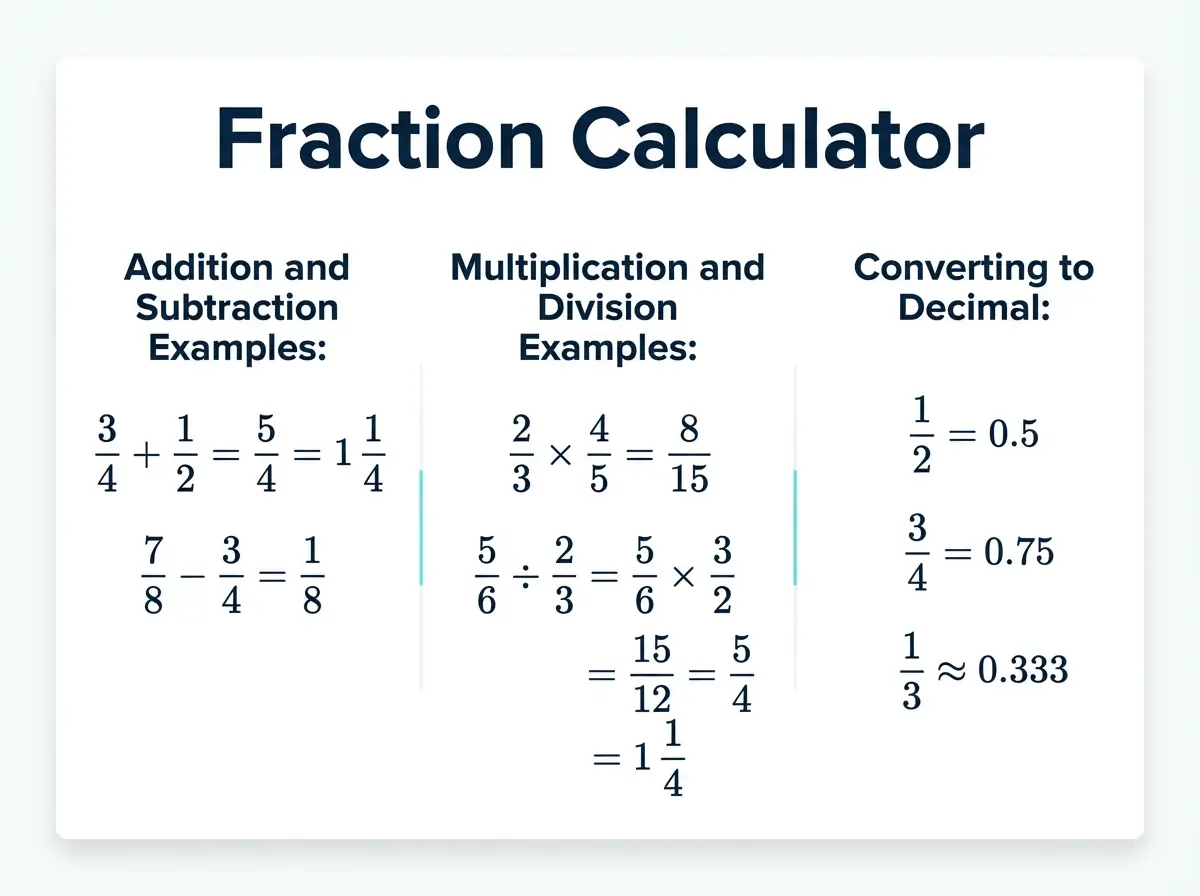
Fraction Calculator
Add, subtract, multiply, and divide fractions. Simplify fractions, convert decimals, and work with mixed numbers easily.
Average Calculator
Calculate the average, sum, count, median, mode, range, minimum, maximum, and weighted average for a list of numbers.
LCM Calculator
Find the least common multiple of two or more integers with exact BigInt results, GCF, prime factorization, formulas, and calculation steps.
Ratio Calculator
Solve A:B = C:D, find missing ratio values, simplify equivalent ratios, scale proportions, calculate percentages, and view ratio diagrams.

Math Expression Evaluator
Evaluate mathematical expressions with this free online tool. Perfect for solving complex equations, calculating values, and more.