1
Add the values
Find the sum of every number in the list. Keep negative signs and decimal places.
Find the average of a list of numbers instantly, or calculate a weighted average with a complete mean, median, mode, range, sum, and count breakdown.
(10 + 2 + 38 + 23 + 38 + 23 + 21) ÷ 7 = 22.1428571429
Add all the numbers, then divide the sum by how many numbers there are. This result is the arithmetic mean—the value most people mean when they say “average.”
Find the sum of every number in the list. Keep negative signs and decimal places.
Count how many numbers were included—not how many digits they contain.
Divide the total from step 1 by the count from step 2 to get the arithmetic mean.
For 2, 7, 19, 24, and 25: sum = 77, count = 5, so average = 77 ÷ 5 = 15.4.
“Average” can describe several measures of central tendency. The best choice depends on the data and the question you are trying to answer.
Σx ÷ n
The familiar sum-divided-by-count average. Best for balanced numeric data without extreme outliers.
middle sorted value
The center value after sorting. It is resistant to outliers and useful for incomes, prices, and skewed data.
most frequent value
The value that occurs most often. A list may have no mode, one mode, or several modes.
Σ(xw) ÷ Σw
Gives values different influence. Common for grades, GPAs, portfolio returns, and grouped data.
ⁿ√(x₁×…×xₙ)
Useful for compounded growth rates and ratios. It requires positive values.
n ÷ Σ(1/x)
Useful for rates such as speeds over equal distances and price-to-earnings style ratios.
A weighted average gives some values more influence than others. Multiply each value by its weight, add those products, and divide by the total of the weights.
Example: grades of 90, 80, and 70 weighted 50%, 30%, and 20% give (90×50 + 80×30 + 70×20) ÷ 100 = 83.
| Value | Weight | Value × Weight |
|---|---|---|
| 90 | 50 | 4,500 |
| 80 | 30 | 2,400 |
| 70 | 20 | 1,400 |
| Total | 100 | 8,300 |
Average test scores or weight assignments, exams, and course credits correctly.
Compare mean, median, mode, minimum, maximum, and range for a dataset.
Summarize sales, response times, unit costs, ratings, and performance data.
Calculate average scores, temperatures, measurements, workouts, or daily totals.
Add all the numbers together, then divide the sum by the number of values. For example, the average of 4, 7, and 10 is (4 + 7 + 10) ÷ 3 = 7.
The arithmetic average formula is Average = Sum ÷ Count, or x̄ = Σx ÷ n. Σx is the sum of the values and n is how many values are in the list.
If every percentage has equal importance, enter the percentages as ordinary numbers and calculate their arithmetic mean. If categories have different importance, use the weighted average mode instead.
Multiply each grade by its course credit or category percentage, add the products, then divide by the total weight. Grades 90, 80, and 70 with weights 50, 30, and 20 have a weighted average of 83.
The mean is sum ÷ count, the median is the middle value after sorting, and the mode is the most frequent value. They can differ when data is skewed or contains outliers.
Yes. This calculator accepts positive numbers, negative numbers, zero, decimals, and scientific notation. For example, the average of −5, 0, 5, and 10 is 2.5.
Remove the highest and lowest values from the list, then calculate the mean of the remaining values. This is sometimes called a trimmed mean and can reduce the effect of outliers.
Use =AVERAGE(A1:A10) for an ordinary mean. For a weighted average, use =SUMPRODUCT(values, weights)/SUM(weights).
No. The mean summarizes the center of a group and does not need to appear in the original data. The average of 2 and 3 is 2.5, even though 2.5 is not in the list.
The median is usually more representative when a few unusually high or low values skew the data. Compare both: a large difference between the mean and median can signal skew or outliers.
Only when the groups contain the same number of observations. For groups of different sizes, calculate a weighted average using each group’s sample size as its weight.
Average speed is total distance ÷ total time, not usually the simple mean of two speeds. Equal-distance trips at different speeds require a harmonic-style calculation.
Useful tools selected for this workflow
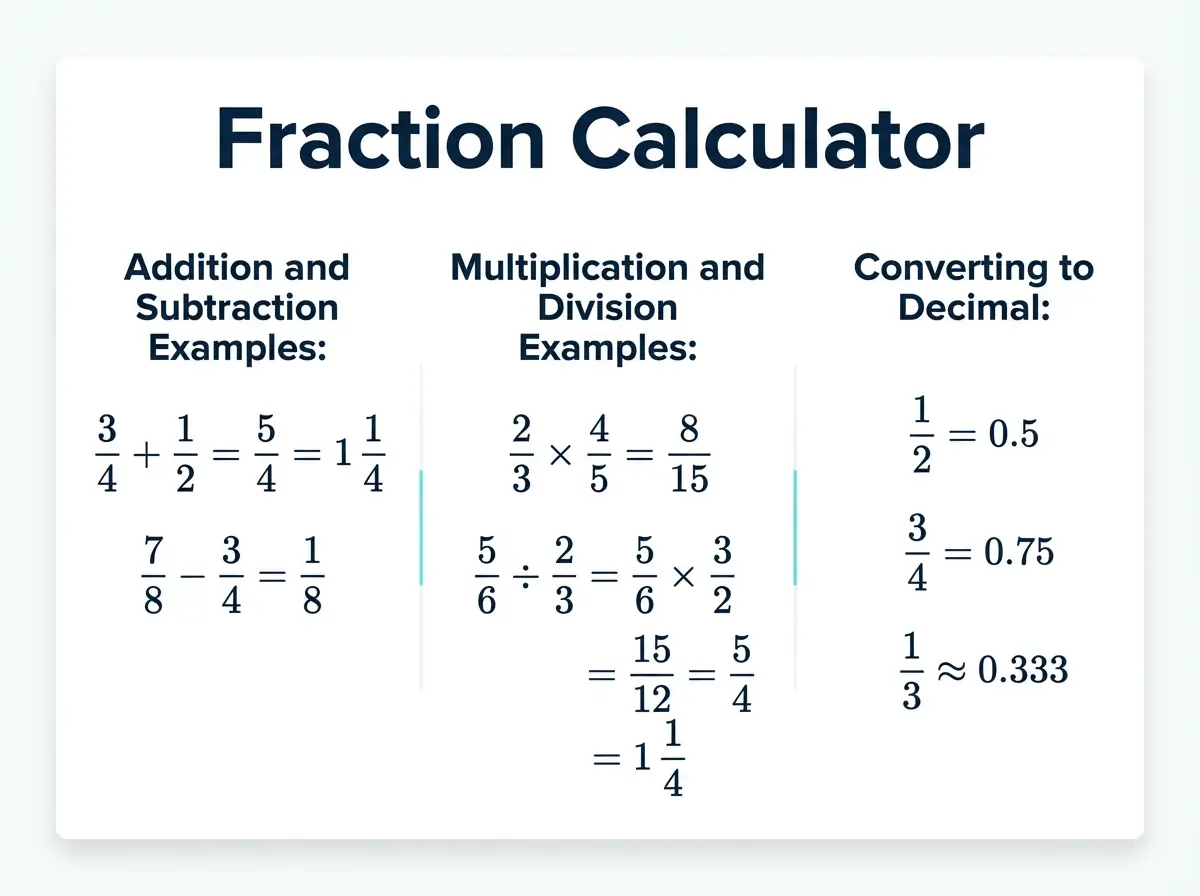
Add, subtract, multiply, and divide fractions. Simplify fractions, convert decimals, and work with mixed numbers easily.
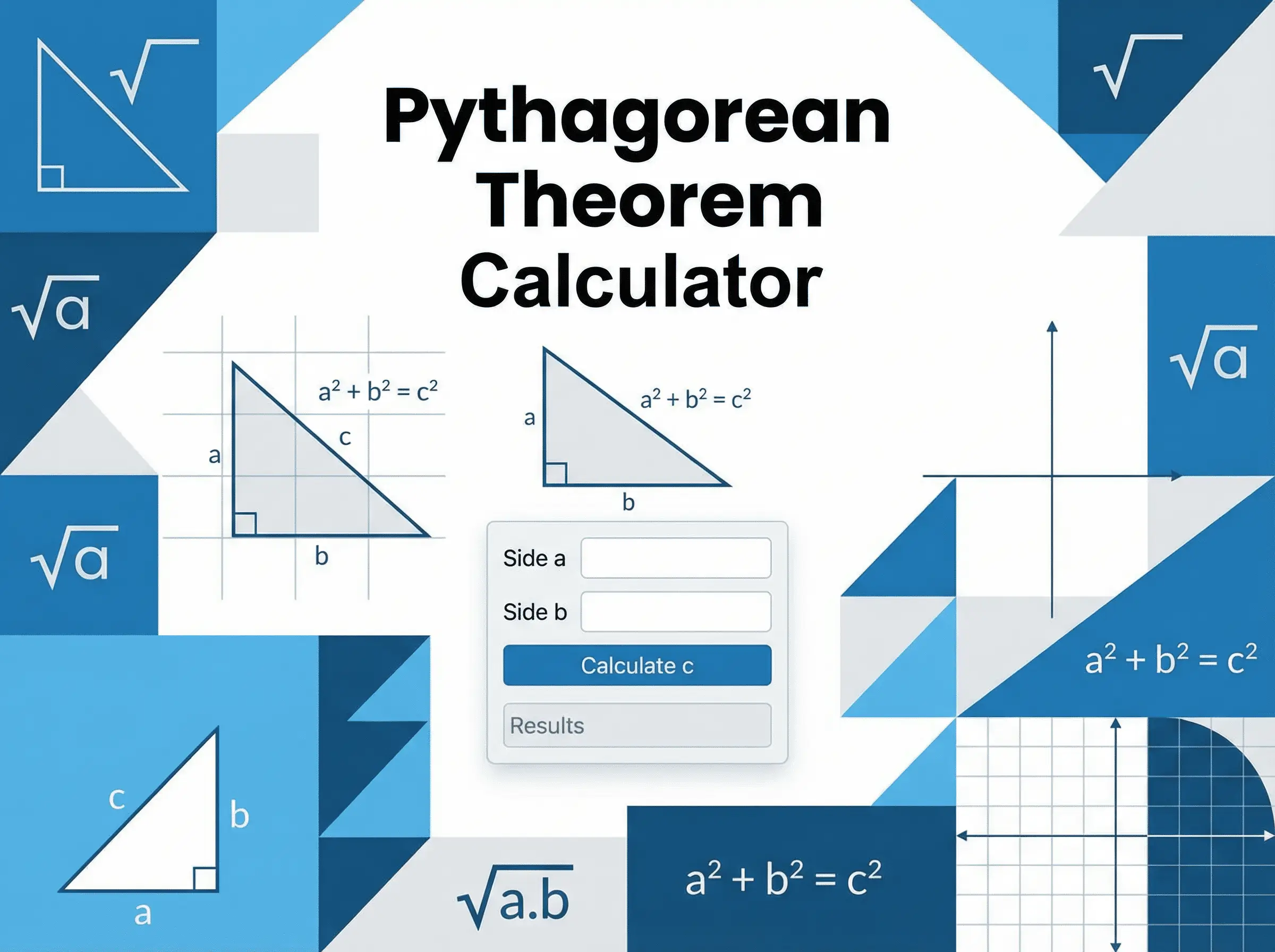
Calculate the missing side of a right triangle using the Pythagorean theorem (a² + b² = c²). Free online calculator with step-by-step solutions.
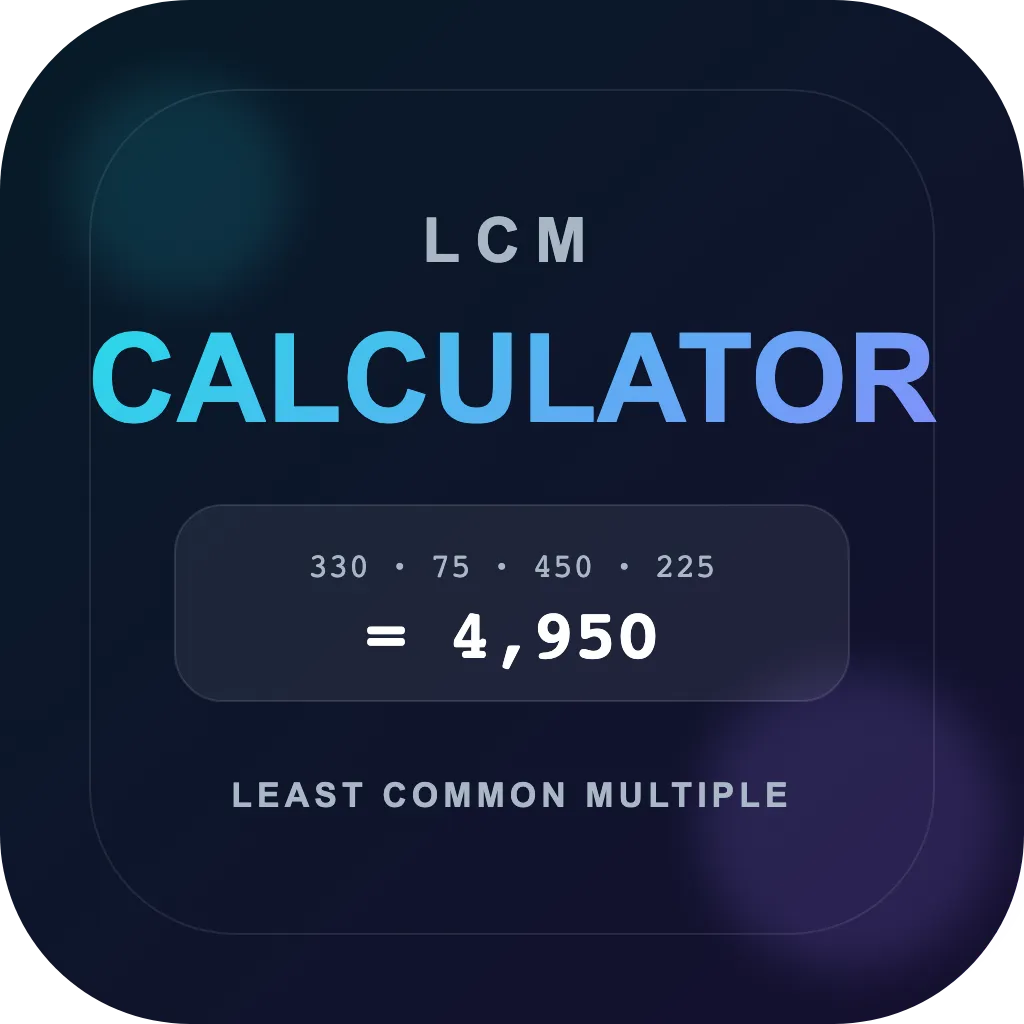
Find the least common multiple of two or more integers with exact BigInt results, GCF, prime factorization, formulas, and calculation steps.

Solve A:B = C:D, find missing ratio values, simplify equivalent ratios, scale proportions, calculate percentages, and view ratio diagrams.

Find exact and decimal distances between two points in 2D or 3D with coordinate differences, midpoint, and step-by-step formulas.

Evaluate mathematical expressions with this free online tool. Perfect for solving complex equations, calculating values, and more.