Gravel Calculator
Work out how much gravel you need for a driveway, path, patio, or drainage project. Enter your area and depth for instant results in cubic yards, cubic feet, tons, pounds, and 50‑lb bags — with an optional cost estimate.
Project Details
Live Results
📐 How the Gravel Calculator Works
- • Gravel (¼–2"): 1,680 kg/m³ (~105 lbs/ft³)
- • Gravel with sand: 1,920 kg/m³ (~120 lbs/ft³)
- • Crushed stone: 1,602 kg/m³ (~100 lbs/ft³)
- • Dry / wet sand: 1,600 / 1,920 kg/m³
- • 1 yd³ = 27 ft³ = 0.7646 m³
- • 1 m³ = 1,000 L = 35.31 ft³
- • 1 ft = 12 in = 0.3048 m
- • 1 inch = 2.54 cm
🪨 Types of Gravel
Gravel is a loose aggregate of small rock fragments. It is sorted by stone size and origin, and each type suits different jobs — from a structural driveway base to a decorative garden top layer. Pick the material in the calculator that matches your project, since density (and therefore weight and cost) varies between types.
Small, smooth, rounded stones (~⅜"). Popular for paths, patios, and playgrounds thanks to its soft feel and good drainage.
Machine-crushed angular rock that locks together tightly. Ideal as a compactable base for driveways, paths, and patios.
Larger, naturally tumbled smooth stones. Decorative ground cover, dry creek beds, and drainage features.
Naturally occurring sand-and-gravel mix (bank run) dug from pits. A cheap, versatile fill and sub-base material.
Mixed stone-and-fines blend that compacts into a solid foundation under driveways, sheds, and pavers.
Fine aggregate used for bedding, leveling, and as a setting layer beneath pavers and flagstone.
What Is Gravel Used For?
Compactable crushed stone or bank gravel makes a durable, well-draining driveway surface. Use 4–6 inches depth.
Decorative ground cover, garden paths, and borders. Pairs with landscape fabric to suppress weeds.
French drains, trench fills, and dry wells — gravel lets water flow while filtering out soil.
Sub-base and fill under concrete slabs, footings, and pavers to spread load and prevent settling.
Rock gardens, pond edges, and dry creek beds where colour and texture matter most.
Stable footing for farm tracks, gateways, and animal pens that drain quickly after rain.
Quick Coverage Guide
Gravel Volume, Density, and Delivery Allowance
Multiply your area by the depth to get volume, then by the material density for weight. This calculator does it automatically — just enter length, width (or area) and depth, and read the result in cubic yards, tons, and bags.
For a decorative top layer, 2–3 inches is plenty. For a driveway, use 4–6 inches (often in two compacted layers). Drainage trenches typically need 4–8 inches.
Most gravel weighs about 1.4 short tons per cubic yard (~2,800 lbs). Crushed stone and wet material can be a little heavier. The calculator uses the exact density of the material you select.
Bulk gravel typically runs $25–$65 per ton or $35–$85 per cubic yard, depending on type and region. Bagged gravel costs more per pound. Enter your supplier price for an instant cost estimate; delivery is usually extra.
The calculator divides total weight by 50 lbs and rounds up. As a rough guide, a 10 ft × 10 ft area at 2 inches deep needs roughly 35–40 bags. Buying in bulk by the ton or yard is far cheaper for larger jobs.
Base gravel (e.g. crushed stone with fines) compacts into a solid foundation, while surface gravel (like pea gravel or river rock) is the decorative top layer. Driveways usually use both — a compacted base topped with finer stone.
Switch to Circle mode and enter the diameter. The tool uses π × (d÷2)² × depth. A 12 ft-diameter patio at 3" deep needs about 1.05 yd³ (~1.4 tons).
Related Tools
Useful tools selected for this workflow
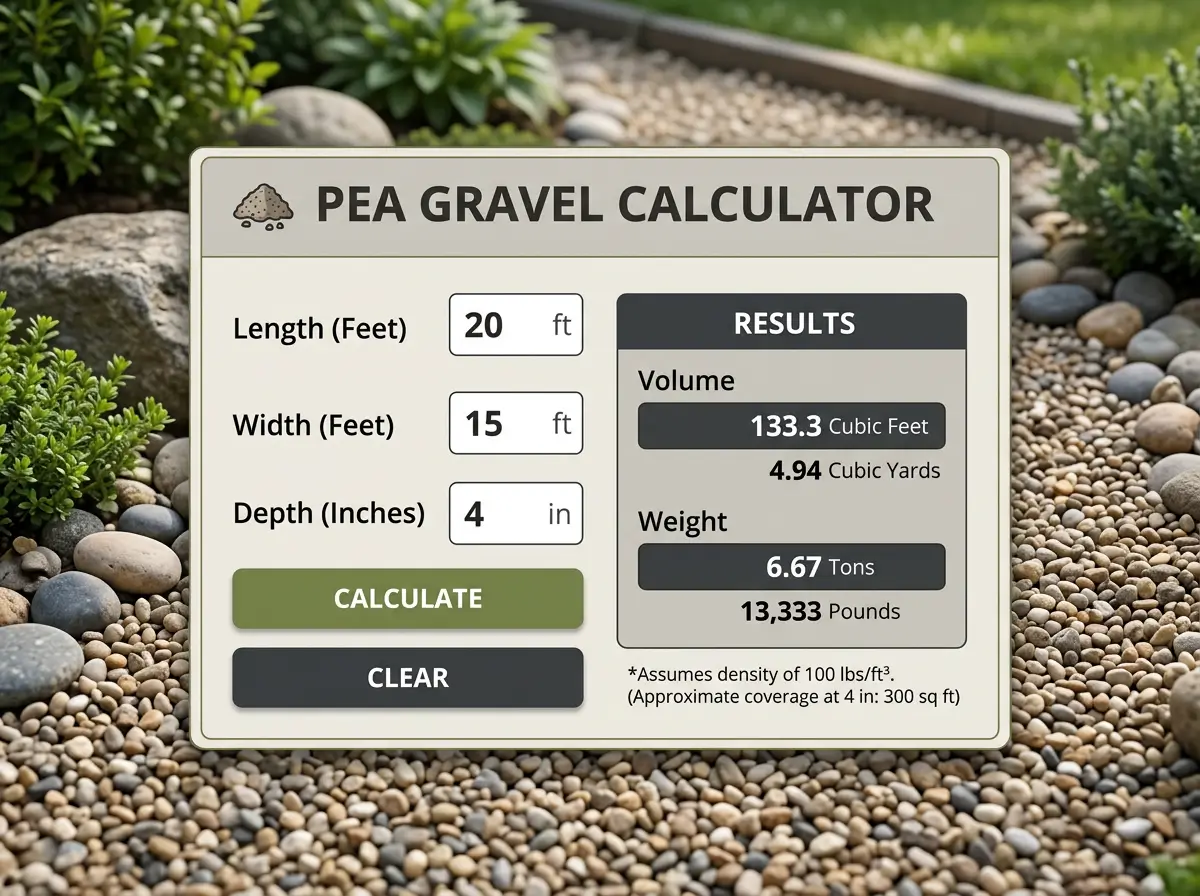
Pea Gravel Calculator
Free pea gravel calculator — estimate how much pea gravel you need by area and depth. Get instant results in cubic yards, cubic feet, tons, lbs, kg, and 50-lb bags. Supports rectangle, circle, and custom area input with optional cost estimate.
Mulch Calculator
Free mulch calculator — estimate how much mulch you need by area and depth. Instant results in cubic yards, cubic feet, 2-cu-ft bags, and weight. Supports rectangle, circle, and total-area input with mulch types and optional cost.
Concrete Calculator
Calculate the volume of concrete needed for your project. Perfect for calculating the volume of concrete needed for your project.
Tire Size Calculator
Calculate tire dimensions, compare tire sizes, and understand tire codes. Free online tire size calculator with diameter, circumference, and speedometer calibration.

BTU Calculator
Calculate BTU requirements for heating and cooling. Estimate AC BTU needs for rooms and houses based on size, insulation, climate, and other factors.

Fuel Cost Calculator
Estimate your trip's fuel cost based on distance, fuel efficiency, and gas price. Supports miles, km, MPG, L/100km, km/L, per gallon, and per liter. Includes round-trip mode and vehicle presets.